
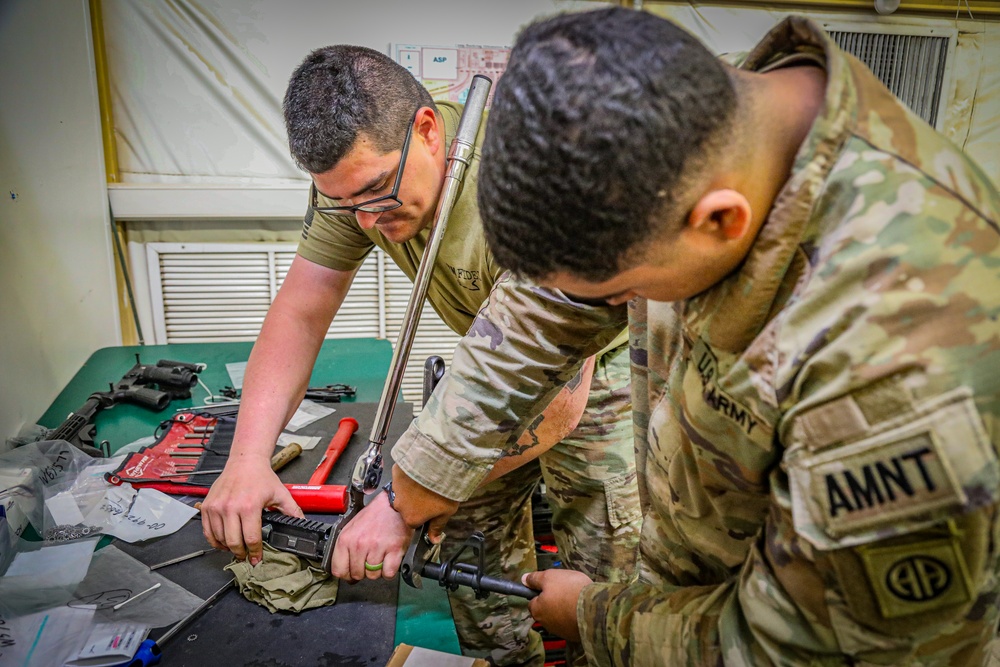
A part coming off a 3D printer can look like a successful repair before it has proved it can do the job. In an Army Sustainment article published October 21, 1LT Ya Xing He examines the limits of additive manufacturing in field maintenance. His central argument is that printers can help sustain equipment, but their value depends on the people, materials, testing and support behind them. This is professional analysis, rather than an announcement of a new Army-wide maintenance policy.
Why should Soldiers and NCOs care? For a maintenance section, a quick replacement is useful only if leaders understand what that part can withstand and how it fits into the repair process. A printed component that fits on the bench may behave differently after exposure to moisture, heat, sunlight or impact. For section sergeants and maintenance leaders, the article offers a practical way to discuss readiness: evaluate the repair and its limitations, rather than treating the ability to print something as proof that the equipment is ready.
He describes two common approaches used in field-level work: fused deposition modeling, which builds with heated filament, and stereolithography, which uses light to solidify resin. Their different demands matter when planning where equipment can operate. The article describes filament-based printing as suited to smaller, mobile maintenance locations, while resin printing requires a stable platform and presents additional transportation and processing challenges. Neither approach removes the need for technical expertise.
Material selection is one recurring problem. The author describes a succession of printed terminal covers that encountered different failures, including brittleness, moisture-related deformation and sunlight degradation. The lesson for a leader is to ask about the intended operating environment before assuming one material is a reliable substitute for another. A successful demonstration in one location does not establish that the same part will perform the same way everywhere.
The article also explains that print orientation can affect a part's strength. Dimensions and fit introduce further complications: warping, interrupted printing, equipment condition and missing engineering specifications can all affect the result. These concerns make operator training and access to manufacturing expertise part of the maintenance discussion. The printer itself is only one piece of the capability.
Another distinction has direct relevance to equipment status. He separates final-use parts that have undergone rigorous testing and clearance as replacements from limited-use parts associated with temporary or expedient repairs. He emphasizes that additive manufacturing supplements the normal Class IX supply process. In the limited-use repair situation he describes, correct replacement parts still need to be ordered and the equipment's technical status properly recorded. The article should not be read as blanket authorization to print a replacement or declare equipment fully mission capable.
There are organizational challenges as well. The author describes procurement delays and warns that consumer printers' wireless connections, cloud services and software-update features raise information-security concerns. His recommendations center on collaboration with allied trade specialists and the wider sustainment enterprise, alongside sustained investment in Soldiers' technical development. He identifies 91E Allied Trade Specialists and 914A Allied Trades Warrant Officers among the sources of relevant expertise.
For an NCO professional-development discussion, the useful questions are concrete: What is the part intended to do? What conditions will it face? Who can evaluate the material, design and manufacturing limitations? Is the repair temporary, and how will its status and replacement requirement be tracked? Those are discussion points drawn from the author's analysis, not new procedures. The broader takeaway is that dependable maintenance innovation requires trained Soldiers and informed leadership as much as it requires new equipment.
Source: Army Sustainment: A Magic Bullet Still Needs Zeroing — Avoiding Pitfalls in 3D Printing for Army Maintenance, by 1LT Ya Xing He, October 21, 2026.